

Documentation
Learn how to configure capture schedules, timezones, trigger windows, and cloud storage — from first setup to production workflows.
Browse sections
Need help?
Contact SupportTrigger Windows
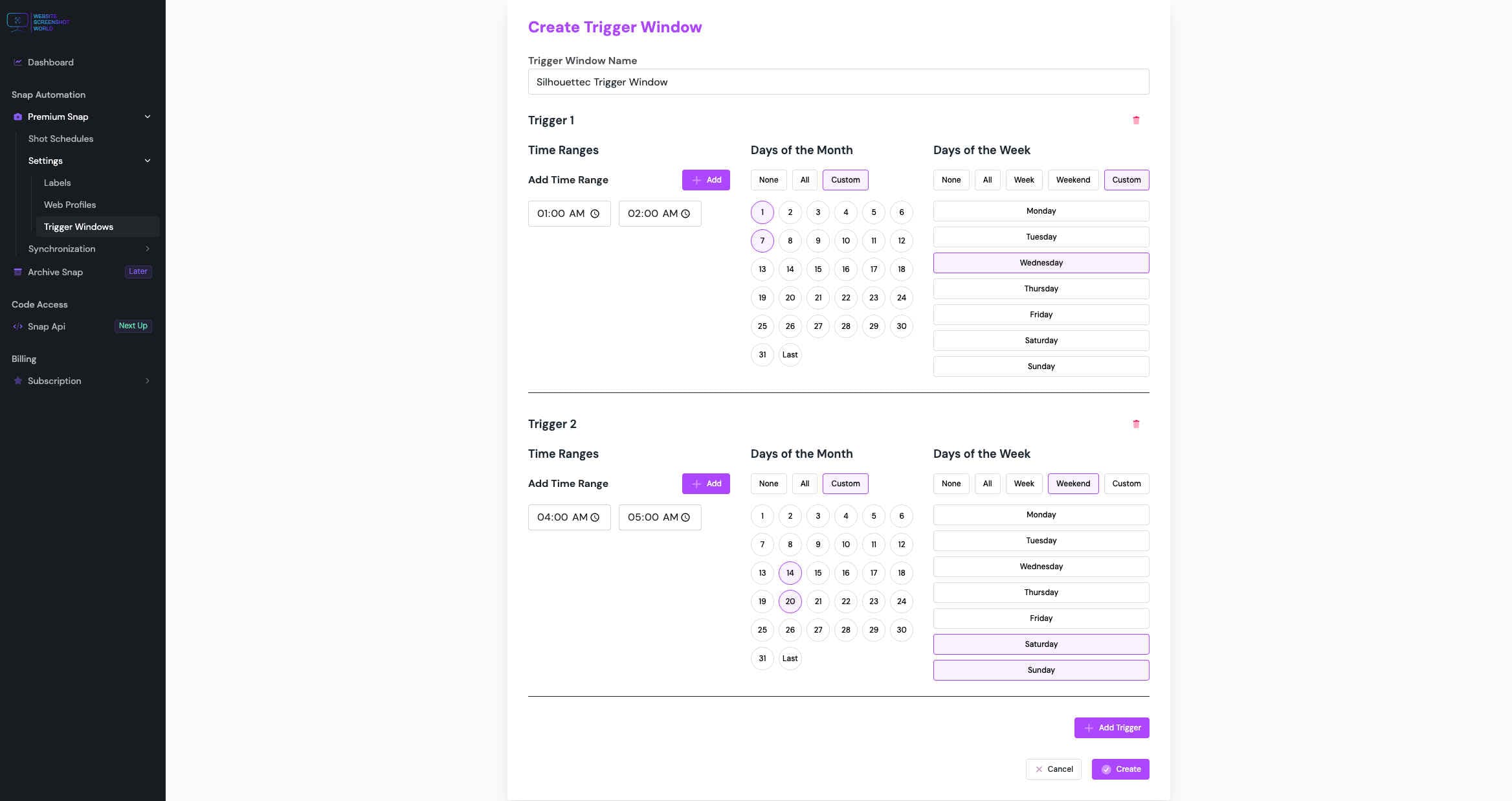
Trigger Windows define when schedules are allowed to run: pick days (week or month) and one or more time ranges. If a schedule is due outside the allowed window, it waits until the next valid window.
Think of Trigger Windows as reusable “business rules” for timing. Attach one to a Web Profile (recommended) to enforce consistent behavior across many schedules, or attach directly to a single high-value schedule.
Concept
A Trigger Window typically includes:
- A name (e.g., “Weekdays 9–5” or “Month-end audit”)
- Trigger Days (which days are allowed to run)
- Trigger Times (which time ranges are allowed on those days)
Days: weekly & calendar patterns
Trigger Days let you express both “weekly” and “monthly” patterns:
Week-based
Select Mon–Sun for classic patterns like weekdays or weekends.
Date-based (Day 1–31)
Choose specific dates (e.g., 1st, 15th, 30th) for monthly tasks.
Last day of month
Run at month end regardless of whether the month has 28, 30, or 31 days.
Multiple day rules
Combine rules when you need more complex cycles (e.g., weekdays + month-end).
Times: one or more ranges per day
Trigger Times define one or more “allowed” ranges. This is useful when you want breaks (e.g., lunch) or multiple capture windows.
- Each range has StartTime and EndTime (e.g., 09:00–17:00).
- You can add multiple ranges (e.g., 09:00–12:00 and 14:00–18:00).
- If a schedule is due outside the window, it waits for the next valid time.
Hourly interval example
Trigger Windows don’t automatically create “every 1 hour” intervals by themselves—they control allowed time. But you can combine them with an hourly schedule to get clean “run every hour” behavior.
Goal
Capture every hour during business hours, Mon–Fri.
Setup
Schedule: hourly. Trigger Window: Mon–Fri, 09:00–18:00 (your timezone).
What happens? The schedule keeps its hourly cadence, but runs only inside the window. Outside the window, it waits and resumes at the next allowed time.
| Time | Allowed? | Result |
|---|---|---|
| 08:00 | No | Wait |
| 09:00 | Yes | Run |
| 10:00 | Yes | Run |
| 11:00 | Yes | Run |
| 18:00 | Yes | Run |
| 19:00 | No | Wait until next weekday 09:00 |
Attaching Trigger Windows
You can attach a Trigger Window at different levels depending on how widely you want it applied:
Attach to a Web Profile
Recommended. All schedules using that profile follow the same time rules.
Attach to a specific schedule
Best for special cases (legal pages, pricing pages, audits, experiments).
Examples
- Business hours: Mon–Fri, 09:00–17:00 (use your business timezone).
- End-of-month audit: Last day of month, 18:00–19:00.
- Weekend-only monitoring: Sat–Sun, 10:00–22:00.
- Campaign window: Weekdays, 08:00–20:00 during a promo period.
- Hourly business monitoring: Mon–Fri, 09:00–18:00 + hourly schedule.
Continue
Next, connect cloud storage so captures are delivered automatically.